Three by Three: Guest Artists in Focus
QUESTION 2. In series like Flowers in Mist, Whispers in Wind, your pieces feel both expansive and intimate. What guides you when deciding how much detail to reveal versus what to leave dissolved into atmosphere?
ANSWER 2. Vast concepts into minimalist rhythm
“Earth is a very small stage in a vast cosmic arena.” —— Carl Sagan, Pale Blue Dot
Carl Sagan’s revelation dismantles our illusions of grandeur: on that faint blue pixel drift our triumphs and tragedies—every ideology, every empire, every worship of the self. Minimalism, then, becomes an ethical stance: to confront our insignificance without surrendering meaning. In my work, absence is presence; the void is a field of ultimate attention. A single point of light—a hesitation of ink, a particle of radiance—asserts that the universe speaks most profoundly through what it withholds.
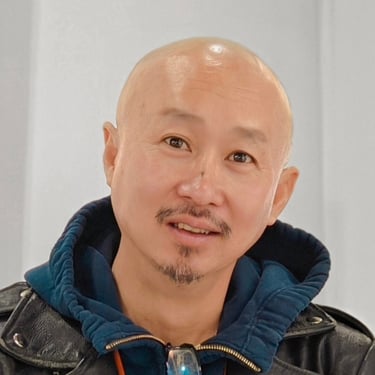
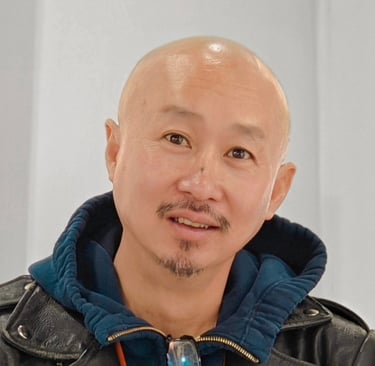
Ziqi Yu
Digital Artist
MEDIUM : Adobe Illustrator, Adobe Photoshop
BIO: I am Ziqi Yu, born in Guangzhou and raised in the U.S., where two contrasting cultures shaped my creative journey. I graduated from the ArtCenter College of Design in Pasadena, California, with dual degrees in Graphic Design and Environmental Design. Over the past 25 years, I have worked across the creative industries in both the U.S. and China, serving as Creative Director at Sapient, Magnet, and MarchFIRST, where I developed brand strategies and visual identities for multinational corporations.
Yet, design was only the beginning of my journey. Over time, I transformed this professional foundation into a deeper artistic practice—one that fuses Eastern aesthetics with modern abstraction. My work is inspired by the wabi-sabi philosophy of Sen no Rikyū and the concept of emptiness (liubai) as a spiritual threshold, where absence becomes presence.
WEBSITE: TaygetaGallery
QUESTION 3. With your bicultural upbringing in Guangzhou and the U.S., how do you see East–West dialogues shaping not only your aesthetic decisions but also the emotional tone and contemplative energy of your work?
ANSWER 3. My upbringing between Guangzhou and the United States gave me two cosmologies: ink teaches that emptiness breathes; Western abstraction teaches that form thinks. Their dialogue becomes a telescope—extending emotional sight outward, beyond the horizon of the self. Home is no longer a place, but a vector: a gaze exchanged with the Universe. In that gaze, the spiritual energy of both cultures converges, turning contemplation into starlight.
I hope my art allows viewers to feel that: even in darkness, there is always a hidden light; even in silence, the spirit continues speaking.
QUESTION 1. Your work draws from both wabi-sabi and the Chinese ink painting principle of liubai. How do you navigate the tension between intentional emptiness and expressive form when composing your digital abstractions?
ANSWER 1. Wabi-sabi & Eastern “intentional emptiness”balance
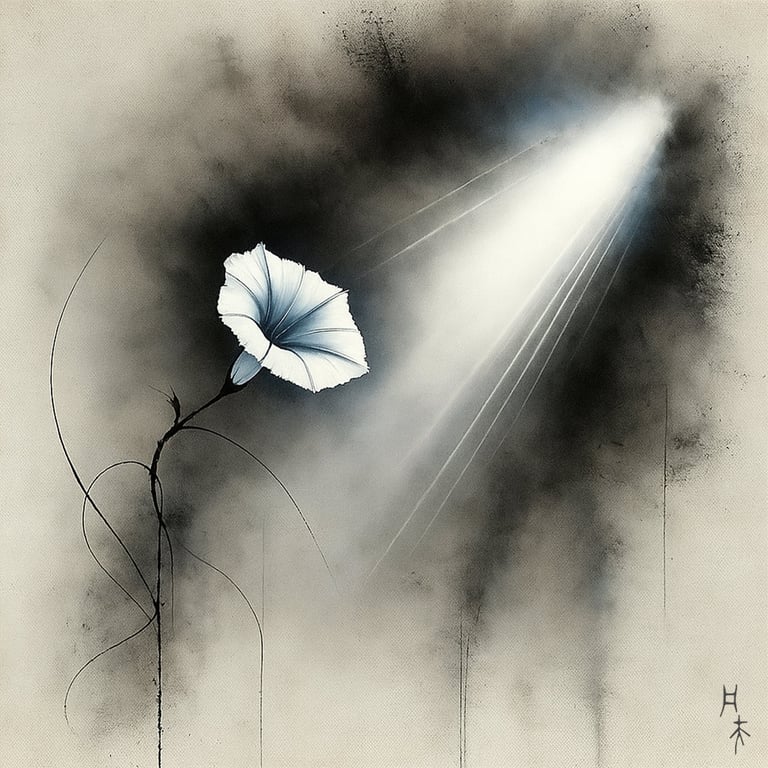
In my digital abstraction, emptiness is never absence — it is an intentional space for breath, silence, and revelation. Wabi-sabi and Chinese ink aesthetics teach me that what is not painted often speaks the loudest.Forms emerge like constellations in a cosmic void — expressive yet humble — allowing the viewer to project their inner cosmos into the unspoken space.
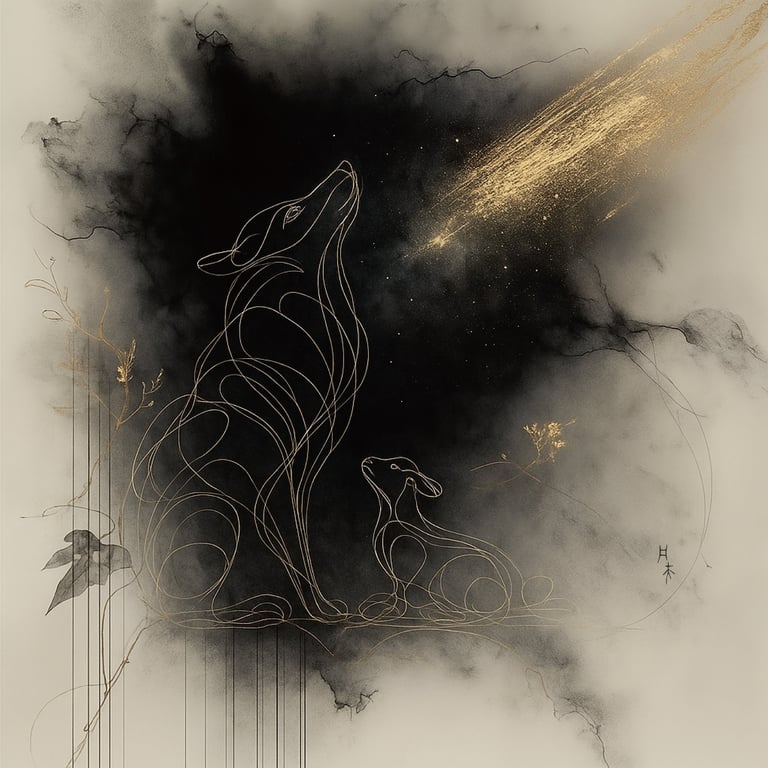
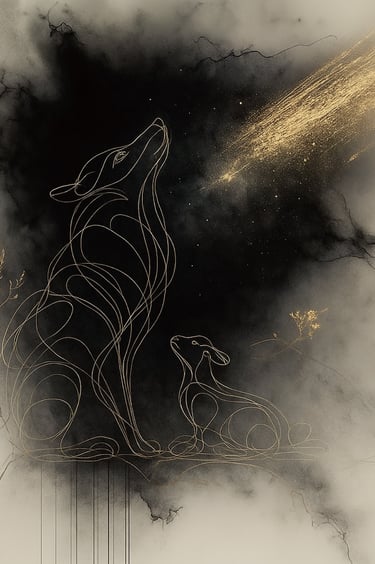
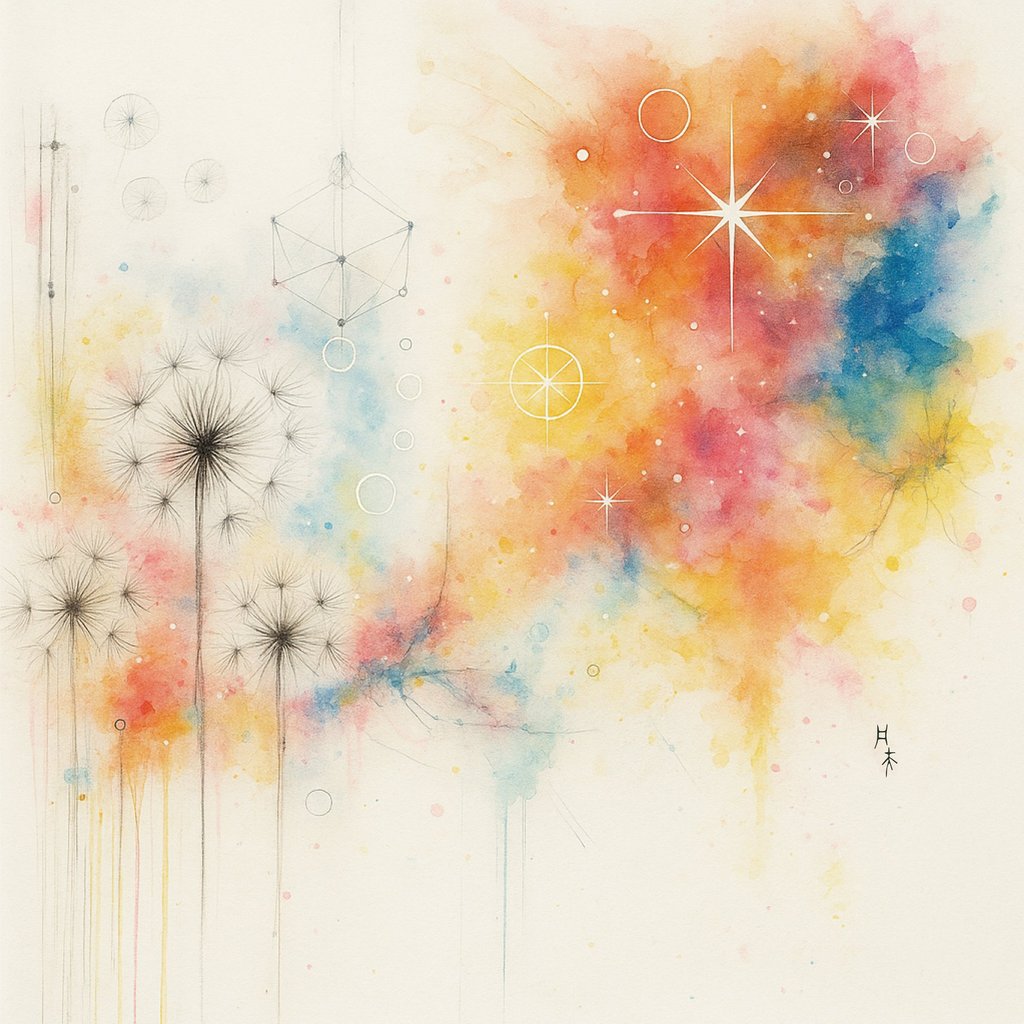
Celestrial Prayers II, 2025, Digital Art print on Cavas, 90x90cm
Flowers in Mist, Whispers in Wind XVI, 2025, Digital Art Print on Acid-free Chinese Xuan Paper, 60x60cm (90x90cm with Frame)
The Final Reconcilision II, 2025, Digital Art print on Cavas, 90x90cm
All copyright and reproduction rights are reserved by Ziqi Yu.
Artwork may not be reproduced in any form without the artist's express written permission.
CLICK IMAGE FOR FULL VIEW
CLICK IMAGE FOR FULL VIEW
CLICK IMAGE FOR FULL VIEW
All images and written materials on this website are protected intellectual property. All copyright and reproduction rights are reserved by KC Magrath.
Artwork may not be reproduced in any form without the artist's express written permission.
Any use of this content to train, develop, or operate generative artificial intelligence or machine-learning systems-whether commercial or non-commercial—is expressly prohibited without prior written permission.
Photos by KC Magrath are reduced in resolution and watermarked. Purchased images will be at the resolution listed in the store and without watermarks.
Purchased digital downloads are intended solely for personal use at the prices listed.
For commercial use or inquiries about designating a photo as a Limited Edition, please email.
Licensing Agreement.
Privacy Policy
Cookies Policy
Giveaway1 & Terms