Three by Three: Guest Artists in Focus
QUESTION 2. Because your images are assembled from photographs and sourced material, where does authorship feel most concentrated for you — in selection, transformation, or final orchestration?
ANSWER 2. Creative ownership is a pressing issue in the age of AI. While artificial intelligence offers new opportunities, particularly for composite artists generating discrete visual elements, it is ultimately a tool, not a substitute for artistic intention. I work primarily in Photoshop, a program that has incorporated AI assisted features for many years. However, my compositions are constructed from photographs rather than AI generated imagery. The source images I use are either purchased or drawn from Creative Commons and public-domain archives.
Although my practice is constrained by what others have chosen to photograph—and increasingly by image libraries saturated with AI content—I approach these limitations as a problem-solving challenge. My goal is to create coherent, visually unified compositions from found material. Through careful manipulation of form, scale, light, and narrative, I transform disparate source images into a work that functions as an original expression, grounded in traditional visual principles and authored through my own artistic decisions.


Linda Lewis
Digital Artist
MEDIUM: Photoshop
BIO: I earned an MFA in Fiber Arts from Arizona State University in 1997. During my studies, I was awarded a Fulbright Scholarship to study at the Danish Design School in Copenhagen, Denmark. Upon returning to the United States, I received the graduate school’s highest honor, the Nathan Cummings Foundation Summer Travel Fellowship. After graduation, I developed an extensive record of exhibitions and awards. Over time, my practice evolved from fiber art to digitally constructed photomontages created in Photoshop—a transition completed after my move to Texas in 2005. My first recognition in this medium was winning first prize in Digital Art Media at the 45th International Art Show at the Brownsville Museum of Fine Art. In Jan 2020, Gallery Ex Machina in Barcelona, Spain, invited me to participate in a two-person exhibition. I was later selected for Light Space & Time Online Art Gallery’s 19th Solo Art Series and for featured artist in Living the Photo Artistic Life, Issue No. 93.
WEBSITE: LindaLewis
QUESTION 3. Humor and spectacle often sit alongside darker commentary in your art. What role does it play in helping viewers engage with difficult or unsettling ideas?
ANSWER 3. I want the viewer’s first encounter with my work to be engaging and, ideally, pleasurable. Wit and spectacle provide an accessible entry point, often through the use of quirky or unconventional objects and visual juxtapositions. Humor helps lower resistance; if the viewer is drawn in by amusement or curiosity, they may be more open to engaging with the darker or more unsettling ideas embedded in the work.
Satirical wit has long been shown to influence attitudes and emotional responses, and it has strongly shaped my own sensibility. I was influenced early on by works that paired humor with critique, including television programs such as All in the Family and The Twilight Zone; stage performances by Bette Midler and Les Ballets Trockadero; films like The Rocky Horror Picture Show and The Gods Must Be Crazy; and the writing of Kurt Vonnegut and Philip Roth.
In 2002, I organized an exhibition titled In Stitches: Humor in Contemporary Fiber Art, which further solidified my interest in humor as a serious artistic strategy. More than two decades later, I continue to use it to address difficult social issues—not with the expectation of changing minds, but as a way to articulate my own perspective. Ultimately, I hope the work finds an audience willing to engage with complex ideas through humor, curiosity, and sustained looking.
QUESTION 1. Your work layers symbolism, cultural critique, and narrative density. How do you keep complex ideas readable rather than overwhelming when constructing a composition?
ANSWER 1. I approach complexity as something that unfolds gradually rather than asserting itself all at once. While my work contains layered symbolism and social critique, each composition is anchored by a clear narrative moment or emotional condition—often a pause, encounter, or point of reckoning—so the viewer has an immediate point of entry before encountering deeper readings.
In Abandoned Dolls, the theme of alcoholism is established through direct, recognizable elements. Three female figures sit on the floor of a grimy, deteriorating factory. Two have liquor bottles beside them, while another holds a highball glass filled with amber liquid. A basket of empty bottles signals the extent of the drinking. Because these objects are familiar, they carry symbolic weight without requiring explanation, allowing the image to remain legible even as meanings accumulate.
The underlying narrative emerges through secondary details: the Standard Doll company sign, the decayed factory interior, coquettish outfits, yellowed invoices, a vintage Singer sewing machine, and dressmaking notions. Together, these elements suggest that dolled up women lose their marketability over time and become obsolete. The interplay of dolls, factory, and relics becomes a meditation on disposability, addiction, and fractured identity.
Ultimately, I trust the viewer to navigate complexity at their own pace. The work is intended to be immediately readable, while sustained looking reveals a denser narrative structure, allowing meaning to build over time rather than overwhelm on first encounter.
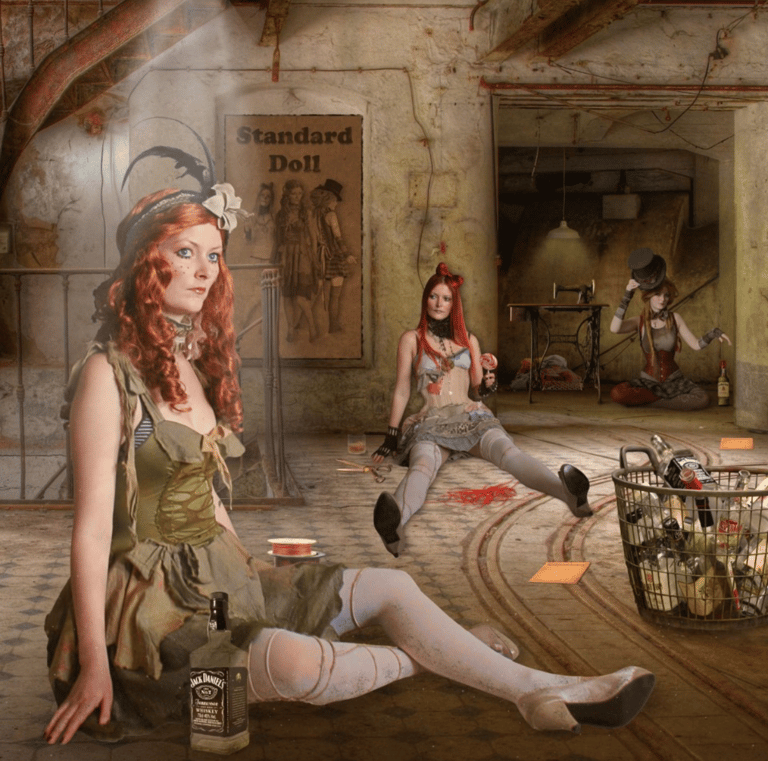
Abandoned Dolls, 2025, Digital Photomontage, 20” x 20”
All copyright and reproduction rights are reserved by Linda Lewis.
Artwork may not be reproduced in any form without the artist's express written permission.
CLICK IMAGE FOR FULL VIEW
CLICK IMAGE FOR FULL VIEW
CLICK IMAGE FOR FULL VIEW
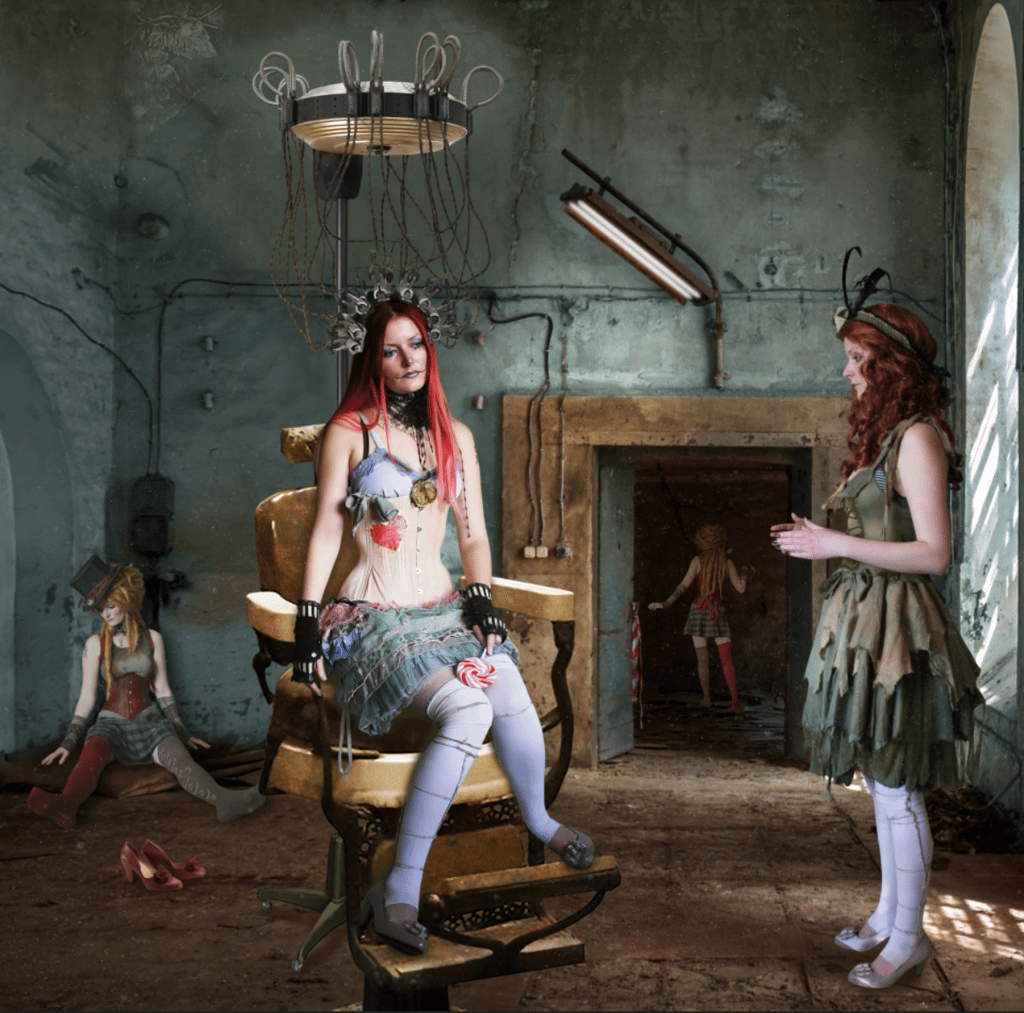
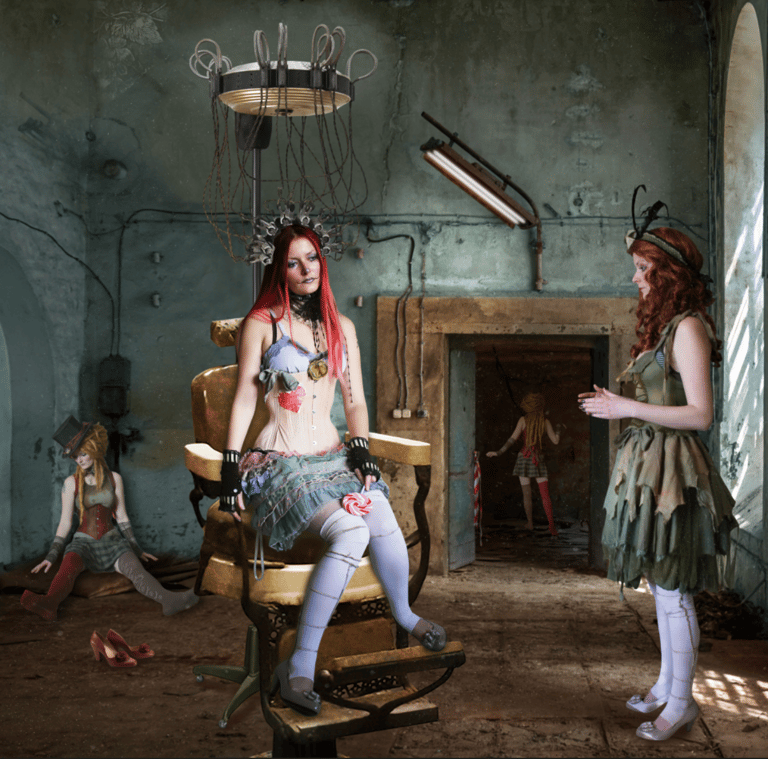
Charging Station, 2025, Digital Photomontage, 20” x 20”
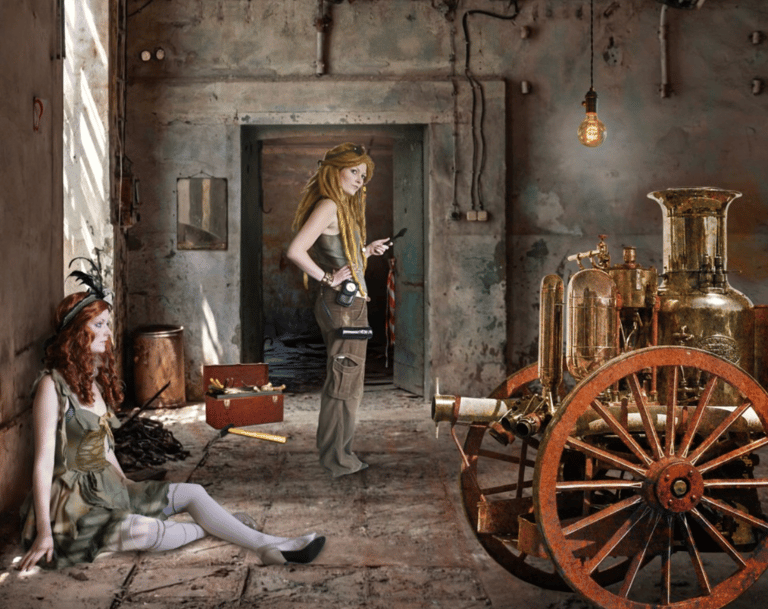
Steam Engine Restoration Project, 2025, Digital Photomontage, 16” x 20"
All images and written materials on this website are protected intellectual property. All copyright and reproduction rights are reserved by KC Magrath.
Artwork may not be reproduced in any form without the artist's express written permission.
Any use of this content to train, develop, or operate generative artificial intelligence or machine-learning systems-whether commercial or non-commercial—is expressly prohibited without prior written permission.
Photos by KC Magrath are reduced in resolution and watermarked. Purchased images will be at the resolution listed in the store and without watermarks.
Purchased digital downloads are intended solely for personal use at the prices listed.
For commercial use or inquiries about designating a photo as a Limited Edition, please email.
Licensing Agreement.
Privacy Policy
Cookies Policy
Giveaway1 & Terms