Three by Three: Guest Artists in Focus
QUESTION 2. Military service is a highly structured, controlled environment. How has working within that reality affected your creative urgency, themes, or need to document inner life?
ANSWER 2. The military, as a restrictive institution, is—and inevitably becomes—a challenge for everyone, but perhaps even more so for an artist. Creation requires space and freedom, particularly freedom of expression.
First, the artist must endure the same constraints as any other person. Beyond that, they are also confronted with the absence of creative materials, privacy, and physical or mental space necessary for the creative process.
Paradoxically, this difficulty can become productive. The artist can draw from the limitation itself—drawing from emotions and mental states that rarely emerge in everyday civilian life.
It is undeniably a difficult scenario: adapting to an environment where art does not naturally grow. Ultimately, it depends on how decisive one is, how deeply one wants to create, and whether one is willing to endure the conditions—not to make art after the service ends, but while still inside it, when the experience remains raw and unresolved.
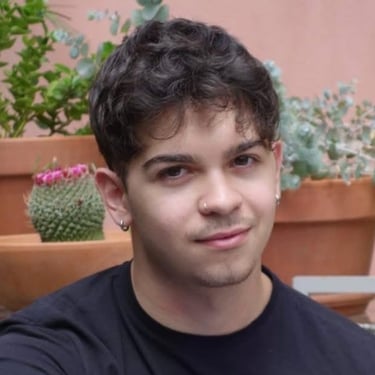
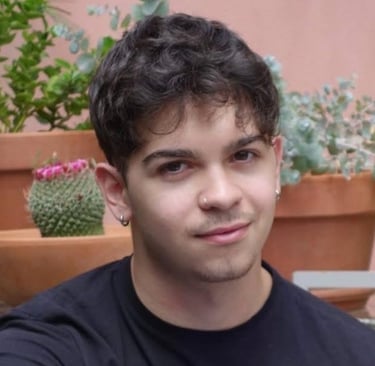
Argyris Lakkas
Visual Artist, Poet, & Photographer
MEDIUM: painting, drawing, mixed-media, digital collage
BIO: Argyris Lakkas (b. 2003) was raised in Elis, Peloponnese, with familial roots in Ikaria. He is a graduate of the Department of Psychology at Aristotle University of Thessaloniki, though his practice extends beyond the academic sphere. During his student years, he participated in artistic workshops as well as painting and photography exhibitions, and his written work has been published in both print and digital media.
For Lakkas, art functions as a vital extension of expression—a means of completing the mosaic of communication. When language proves insufficient, art intervenes to articulate what cannot be spoken.
INSTAGRAM: @ArgirisLakkas
QUESTION 3. Many of your pieces feel like fragments—moments rather than conclusions. What draws you to leaving things unresolved or open-ended?
ANSWER 3. I think this observation touches something essential in my work. My practice draws strong inspiration from Greek history, where one civilization was built upon another: the Minoans assimilated by the Mycenaeans, then by the Dorians, later absorbed into Alexander’s empire and the Hellenistic kingdoms, and so on.
Through time—ruthless and transformative—much was lost. What reaches us today is often a fragment. Yet when we look back at what we call our “golden ages,” we do not see failure or destruction; we learn to admire the beauty of ruins. I do not perceive them as something partially destroyed, but as signs of endurance and preservation.
This perspective aligns closely with modern ideas of art, particularly in relation to the viewer. The artist often remains silent, allowing space for interpretation rather than imposing meaning. The work is offered to the world, and then it belongs to the viewer—to feel it, to connect with it, to grow alongside it.
Fragmentation also invites participation. It asks the viewer to connect the pieces, to engage intellectually and emotionally, to search for threads and pursue knowledge on their own.
Finally, because I often aim to create works that connect different historical timelines of my people, diversity and cultural mixture become inevitable. To an unfamiliar eye, these elements may appear incompatible or unresolved—but to those who look closely, the threads connecting them are clearly present.
QUESTION 1. You move fluidly between painting, drawing, mixed-media, photography, and digital collage. What determines which medium becomes the right vessel for a particular emotional or narrative thread?
ANSWER 1. I often answer this question through a metaphor a professor shared with me in my first year of university. In psychology, there are multiple approaches and forms of treatment, and a common trap for beginners is asking, “Which one is the right one?” The answer is: none. There is no absolute right or wrong—only different approaches. Think of it like medicine: not every illness is treated with the same medication. The same applies to psychology, and equally to art.
Mediums, approaches, and techniques are tools. It is up to the artist to choose which one best serves their purpose in a given moment. For instance, when I want to emphasize the creative process rather than the act of making something from scratch, I often turn to collage. That way, my energy is not spent on constructing form, but fully directed toward the final meaning.
Another example is poetry: when I want to be heard clearly, to be understood rather than simply to convey an abstract message, words feel more precise. And so it goes—each emotional or narrative need calls for its own vessel.
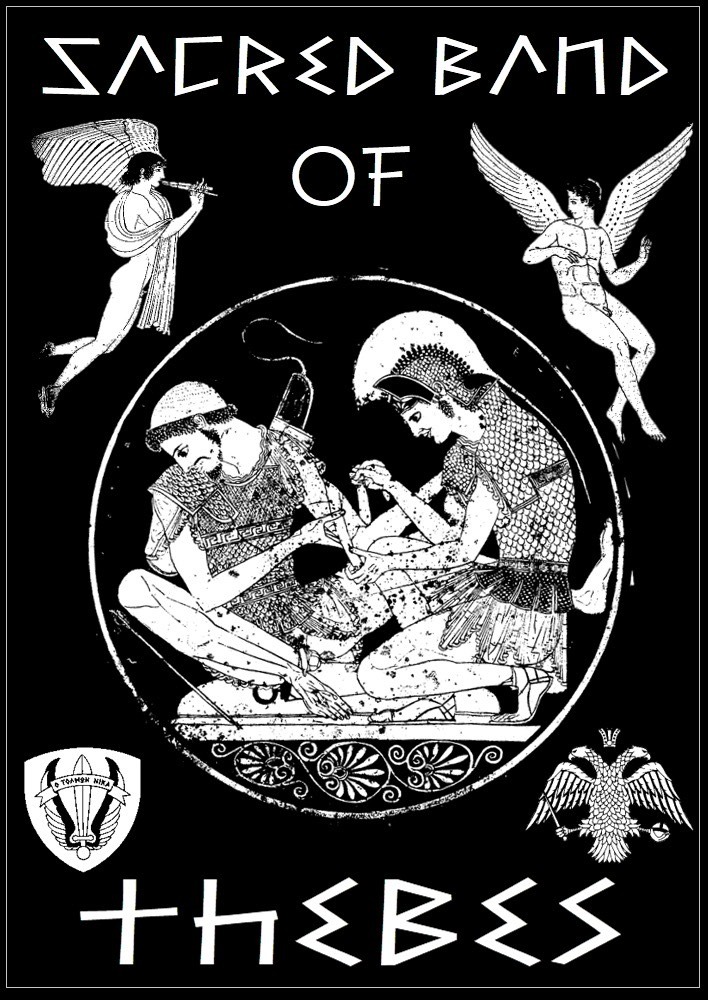
Ιερός λόχος των θηβων (Sacred band of Thebes), 2025, digital collage
All copyright and reproduction rights are reserved by Argyris Lakkas.
Artwork may not be reproduced in any form without the artist's express written permission.
CLICK IMAGE FOR FULL VIEW
CLICK IMAGE FOR FULL VIEW
CLICK IMAGE FOR FULL VIEW
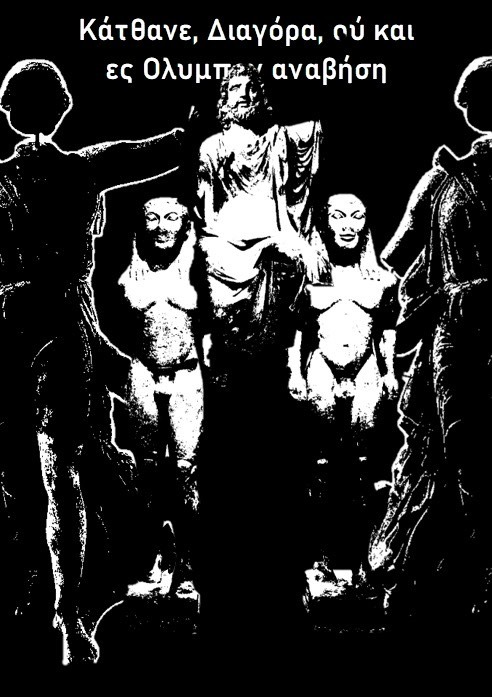
Ο θρίαμβος του διαγορα (Diagora’s Triumph), 2025, digital collage
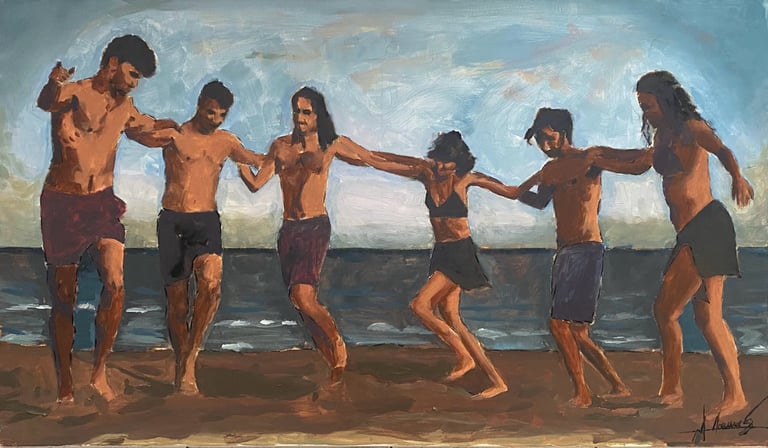
Ικαριωτικος (ikariotikos), 2024, acrylics, 70x120
All images and written materials on this website are protected intellectual property. All copyright and reproduction rights are reserved by KC Magrath.
Artwork may not be reproduced in any form without the artist's express written permission.
Any use of this content to train, develop, or operate generative artificial intelligence or machine-learning systems-whether commercial or non-commercial—is expressly prohibited without prior written permission.
Photos by KC Magrath are reduced in resolution and watermarked. Purchased images will be at the resolution listed in the store and without watermarks.
Purchased digital downloads are intended solely for personal use at the prices listed.
For commercial use or inquiries about designating a photo as a Limited Edition, please email.
Licensing Agreement.
Privacy Policy
Cookies Policy
Giveaway1 & Terms