Three by Three: Guest Artists in Focus
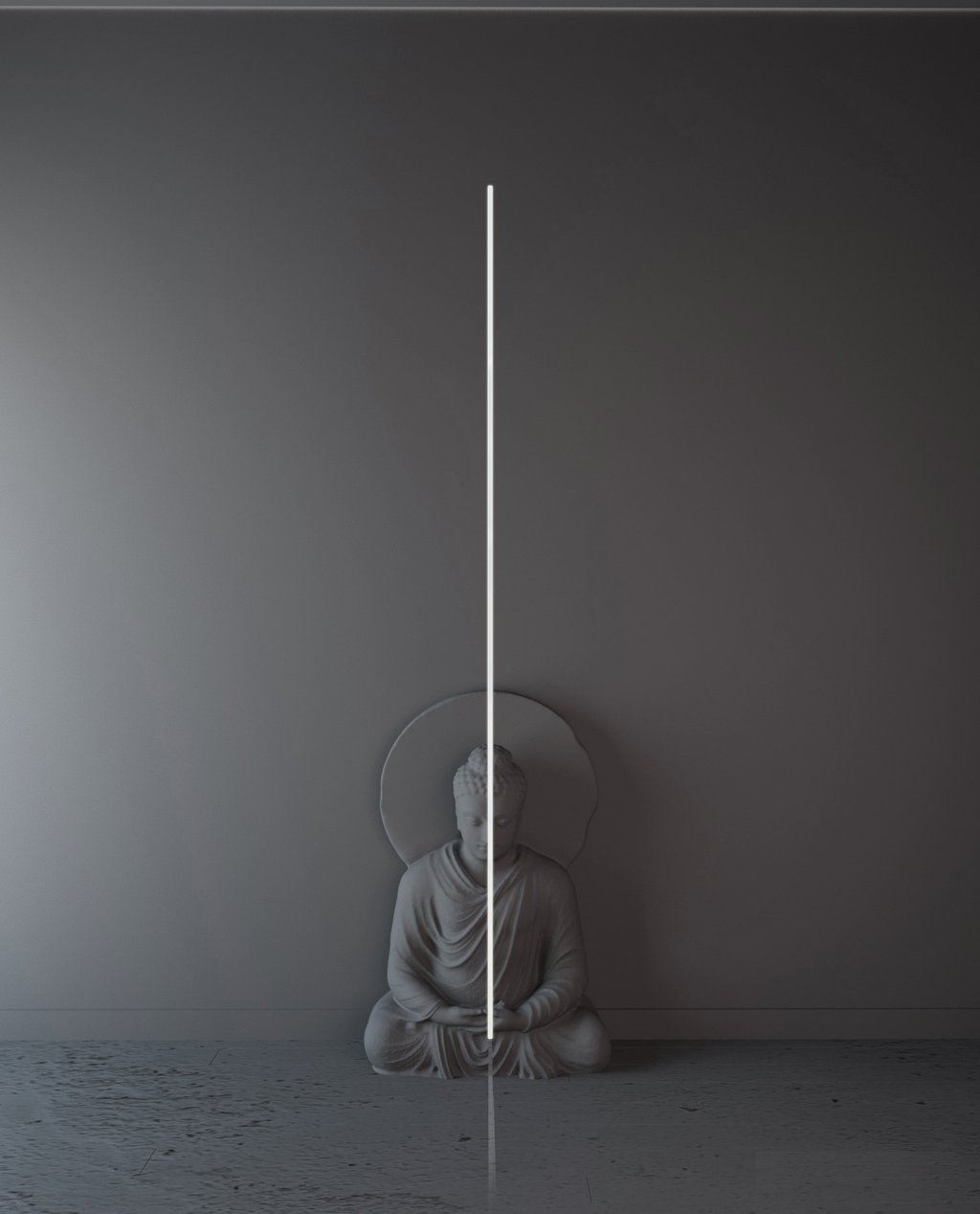
QUESTION 2. In works like <Line for Zen>, lines extend beyond the artwork itself and into the architectural space. What role does the viewer's physical presence play in the completion of the work?
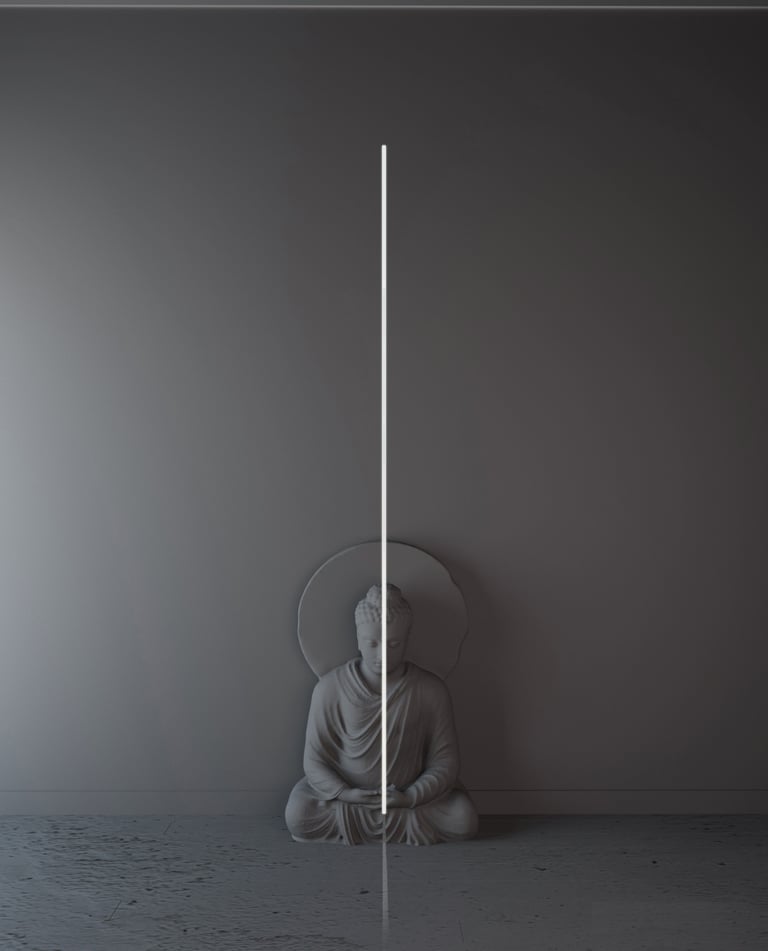
ANSWER 2. If the viewer is to the side, they cannot see the lines. Only when they are in the center can they properly see the lines. This is because the wall behind and the Buddha are pierced by a single line. And because the wall is pierced, natural light creates the lines during the day, and darkness creates the lines at night.
It seems crazy, but the body and mind become one. I think it is like a phenomenon that appears as the three-dimensional space disappears. There is a line there, but I can't see it.
Zen monk (禪僧) Togen (道元)said in Japan:
There's no water in the big sea, so it'll be cool in the spring, It will be with flowers in spring, Cuculus poliocephalus in summer, moon in autumn, and in winter, snow will accumulate and it will be cool.
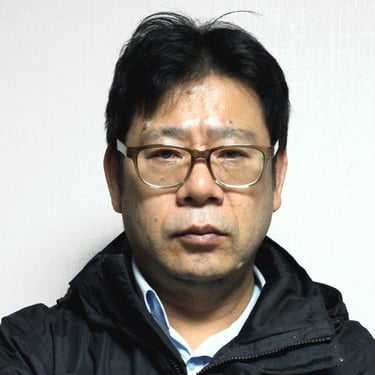
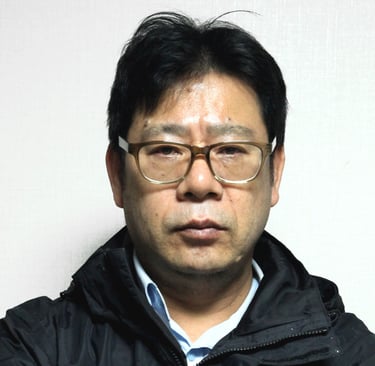
Jang Guin Lim
Painter, Video Artist, Installation Artist
MEDIUM: oil
BIO: I majored in fine arts at a Korean university. After graduation, I began my artistic career at a relatively late age while working at a company.
I work in various fields, including video art, installation art, and painting. The depth of my work may vary, but I believe every piece should convey a message.
Art has been a great help in my growth. My goal is to erase time and space. Art is about flattening three-dimensional objects into two dimensions. While Cubism used cameras from various angles, I flatten objects by unfolding them. For this reason, I'm interested in non-Euclidean geometry. I'm also deeply interested in Maurice Merlot's "Phenomenology of the Body."
INSTAGRAM: @LimJangGuin
QUESTION 3. You began to dedicate yourself to art later in life after a long career in the corporate world. What internal changes did you experience that made this transition feel like a necessity rather than a choice?
ANSWER 3. I was diagnosed with schizophrenia in my 40s and was hospitalized three times, which sent my life into a tailspin.
I barely managed to keep up with my job. I'm still taking medication. The reason I started painting again is because when I paint, I experience delusions and am unable to hear sounds.
When I'm absorbed in a painting, that's when I feel most normal.
QUESTION 1. Your practice repeatedly returns to the act of flattening three-dimensional forms into two-dimensional space. What first compelled you to challenge volume and depth as something that could be unfolded rather than depicted?
ANSWER 1. I've worked in 3D graphics. That involves texture mapping, which involves applying textures to three-dimensional objects. That's where my painting work began.
Painting in art has progressed from perspective to flatness, and with modernism, the truth of painting was revealed. But I'm not talking about the full canvas of modernism. My work is limited to objects. And the Objects overlap, and what's behind them is semi-transparent, like an X-ray. Cubism has a variety of perspectives on its object, and it has no time or space.Also, my painting work is one in which time and space do not exist. For example, when expressing a sculpture of a person, Cubism expresses the object from multiple perspectives rather than just one, but I unfold the object. Then, there is no need for space and time to see the back of the 3D sculpture. This is how Cubism and my working style do not align, I unfold the object and draw its appearance.
One must remain silent about the world of the essence of the inner object. I can only tell you about the surface of the skin shown. My work is a painting in which time and space do not exist, and is the same as Cubism, but the method of expression I pursue is different.
Quantum physicist Carlo Rovelli agrees that time does not flow. Since there is no time, space naturally does not exist. Furthermore, John Steele, a math instructor, said the reason why the surface of a sphere cannot be 'unfolded' has to do with the Gaussian curvature of the surface. The same goes for apples. Even if you break and split them, the curve doesn't change. I'm still looking for something that can completely unfold the object.And in my painting work, when objects overlap, I let the objects in the back slightly penetrate the front. That is a way to eliminate spatiality.
In my work “Line for Zen” I also worked on eliminating spatiality. In that work, the wall and the Buddha becoming one is my important point, so I used lines. And the "Human Shield" project was born out of anger at the news reports of terrorist groups using people as bullet shields. "Where Are We Going?" depicts a bleak future worlds.


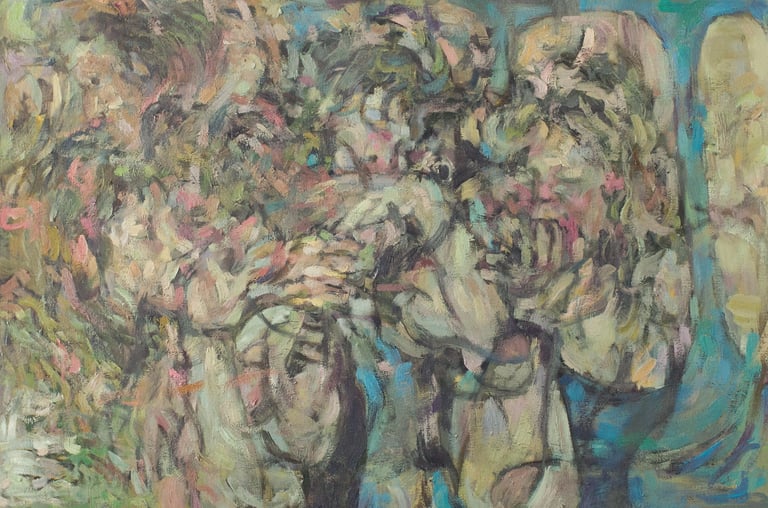
'Human Shield', colored pencil, 20cmx29cm
All copyright and reproduction rights are reserved by Jang Guin Lim.
Artwork may not be reproduced in any form without the artist's express written permission.
CLICK IMAGE FOR FULL VIEW
CLICK IMAGE FOR FULL VIEW
CLICK IMAGE FOR FULL VIEW
'Where Are We Going', oil, 60cmx90cm
'Line for Zen', installation, 1.2m x4m
All images and written materials on this website are protected intellectual property. All copyright and reproduction rights are reserved by KC Magrath.
Artwork may not be reproduced in any form without the artist's express written permission.
Any use of this content to train, develop, or operate generative artificial intelligence or machine-learning systems-whether commercial or non-commercial—is expressly prohibited without prior written permission.
Photos by KC Magrath are reduced in resolution and watermarked. Purchased images will be at the resolution listed in the store and without watermarks.
Purchased digital downloads are intended solely for personal use at the prices listed.
For commercial use or inquiries about designating a photo as a Limited Edition, please email.
Licensing Agreement.
Privacy Policy
Cookies Policy
Giveaway1 & Terms