Three by Three: Guest Artists in Focus
QUESTION 2. In works like Decisions, Decisions, there’s a blend of mischievous humor and quiet contemplation. How do you achieve that balance so each sculpture feels playful yet still thematically resonant?
ANSWER 2. We are deeply drawn to street art wherever we travel. What captivates us is its immediacy, the way a simple, often mischievous gesture can disarm you with humour before quietly slipping a far more serious thought into your pocket. Street art doesn’t ask for permission or prolonged attention; it meets you where you are. That balance of wit and weight has become central to how we think about our own work.
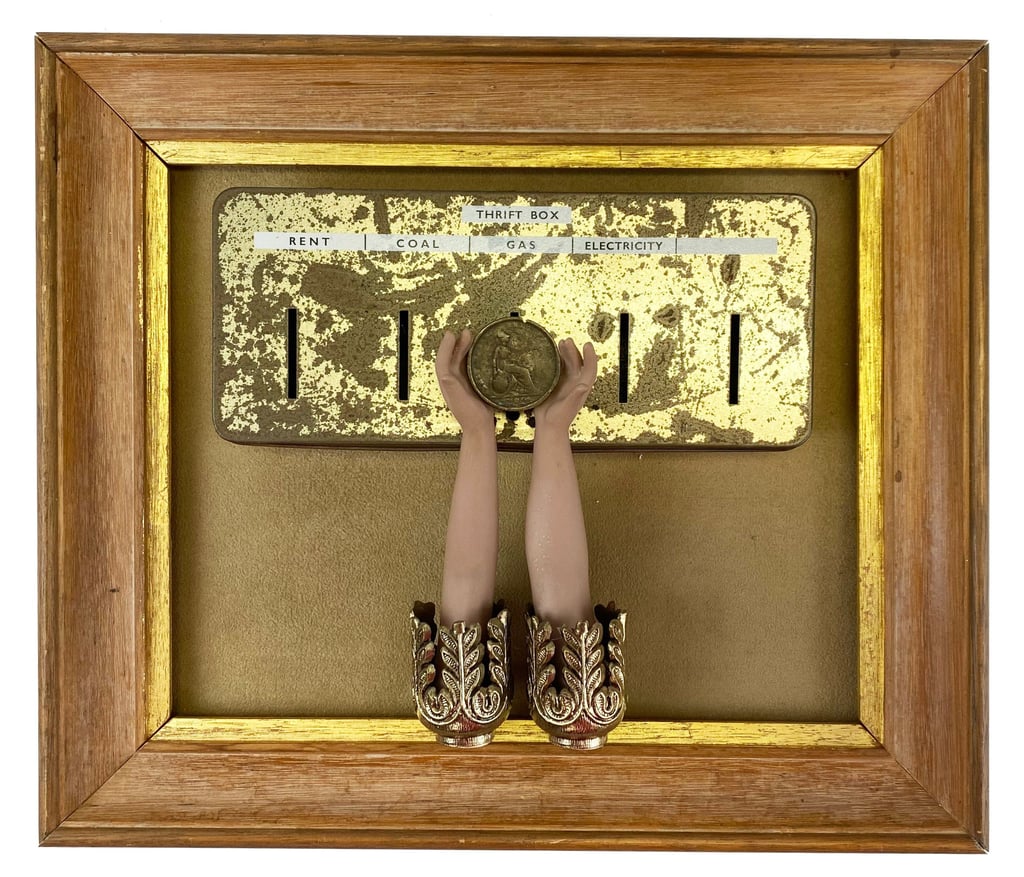
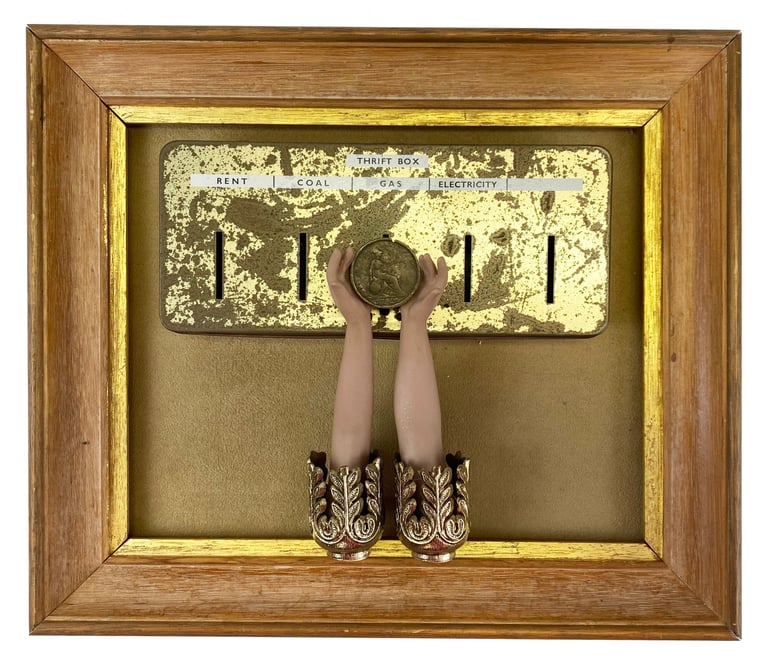
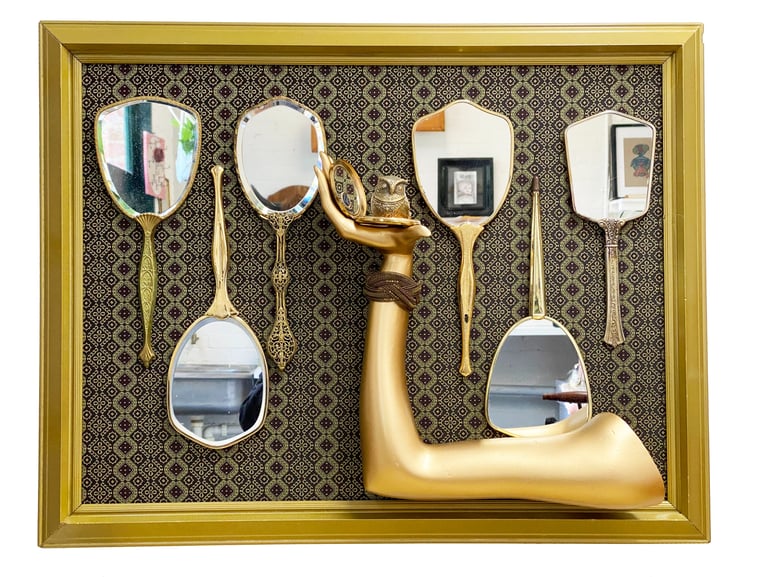
When we begin a piece, humour is often the doorway. Playfulness invites the viewer in, lowers their defences, and creates a moment of recognition or delight. But beneath that surface, we are always wrestling with something heavier. In Decisions, Decisions, the lightness of the form masks a very real anxiety, a reflection on the current cost-of-living crisis and the impossible choices people are forced to make daily. The work asks a blunt, uncomfortable question - when resources are stretched thin, what do we prioritise? Survival or dignity? Bills or food? The humour doesn’t soften the issue so much as sharpen it, allowing the absurdity of the situation to reveal its cruelty. Similarly, The Wisdom of Age uses a quiet, almost tender tone to address aging in the era of social media. We are living in a time where beauty has been relentlessly commodified and youth marketed as a moral virtue. Aging, once associated with experience and authority, is now something to be hidden, filtered, or corrected. This piece reflects on that tension, honouring age as a repository of knowledge and resilience, while acknowledging the pressure to erase its visible signs. For us, achieving balance is less about carefully measuring humour against seriousness, and more about allowing them to coexist naturally. Life itself is often absurd and devastating at the same time. By embracing that duality, each sculpture can remain playful on first encounter, yet linger with the viewer as something quietly unresolved, an object that smiles back at you while asking you to think twice.
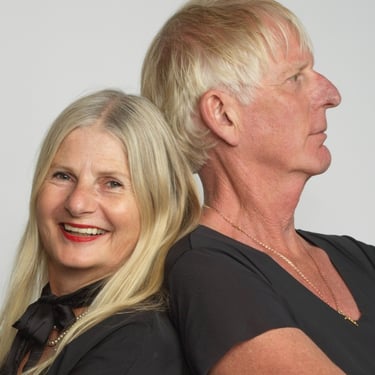
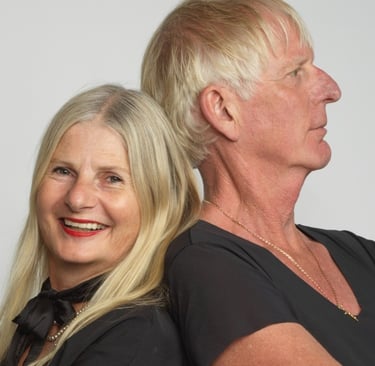
Phill Calvert and Julia Brampton collaborating as KITTY CALVERT
Assemblage Sculptors
MEDIUM: upcycled vintage treasure
BIO: The inspiration for Kitty Calvert's unique one off sculptures, comes from a love of vintage and a desire to re-use and recycle unique pieces of discarded treasure, each piece of treasure being an individual memory carrying vessel. Evoking cherished memories of childhood and making new cool stuff out of old cool stuff.
We invite the viewer to reflect on the concept of waste in the world, of recycling that waste into a new form and the potential journey each individual piece has made to its final resting place inside the sculpture. In today's world where things are designed with obsolescence in mind, we find there is a hankering for things that last.
Kitty Calvert assemblage sculptures are a collaboration of treasure hunt and treasure build, between Melbourne (Australia) based husband and wife Julia Brampton and Phill Calvert. Credit: Photo by Robert Earp
INSTAGRAM: @KittyCalvert
QUESTION 3. Because each component begins life as a discarded relic, how do you determine when a sculpture is complete without overworking the spontaneity and rawness that make the materials compelling?
ANSWER 3. For us, a sculpture is assembled long before it is physically built. The real work happens in a slow, intuitive choreography of looking, testing, and imagining, objects being brought together, separated, and reunited again in the mind and on the table. By the time the first bolt is tightened, the composition has already been decided. Once the building process begins, the work becomes largely irreversible; with so much bolting and screwing involved , and very rarely any glue, each decision carries a sense of commitment and consequence.
This method demands a certain discipline. Mechanical fastening leaves little room for casual adjustment, but that limitation is intentional. It forces clarity and conviction, transforming the act of making into something closer to construction than collage. The structure must be resolved before it is fixed, much like an idea that has finally found its form.
Equally important is the finish. We want each sculpture to be robust, stable, and built to endure. These are not fragile arrangements, but carefully constructed extensions of objects that have already survived one lifetime of use. By finishing them strongly, we allow each small “treasure” to continue its journey, not as a discarded relic, but as something reactivated and given purpose again.
In this way, the work is less about reinvention and more about continuation. The objects are not asked to forget what they were, but to carry that history forward into a new configuration, one that honours their past while allowing them an extended life well beyond their original function.
QUESTION 1. When you build an assemblage from scavenged vintage pieces, how do you decide which objects’ “bed hair,” dents, and patina are essential to preserve within the final composition?
ANSWER 1. When we work with scavenged vintage objects, our first instinct is to listen rather than impose. Each piece arrives carrying its own quiet authority, shaped by touch, use, neglect, and survival. The dents, scratches, and patina are not imperfections to be corrected, but evidence of a life already lived. They are the fingerprints of time. We rarely feel the need to erase these marks because they are where the object’s memory resides. A dent suggests an accident or a moment of force; a worn edge speaks of repetition, habit, and human presence. Even the patina itself feels like a kind of accumulated breath — layers of handling, environment, and years settling into the surface. If these objects could speak, those marks would be their language. Our role, then, becomes one of stewardship rather than transformation. We try to preserve the integrity and history of each item as much as possible, allowing its existing narrative to remain legible within the new composition. By resisting over-polishing or restoration, we let those secret, unknowable stories continue - not as fixed histories, but as open-ended suggestions. In their next life as part of an assemblage, these objects are not reborn as something entirely new; they are extended. Their past and present coexist. The scars remain visible, not as nostalgia, but as proof of endurance - reminders that meaning accumulates over time, and that beauty often lies in what has been worn, handled, and quietly carried forward.
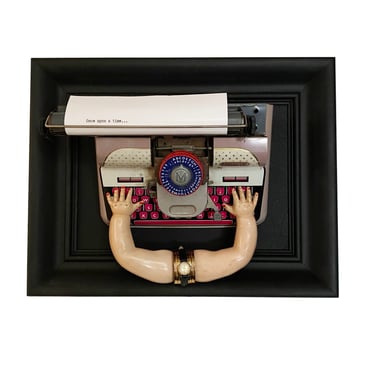
Once Upon a Time, 2024,
upcycled treasure including vintage toy typewriter, doll hands, antique watch, vintage frame, 40 x 30cm
All copyright and reproduction rights are reserved by Phill Calvert and Julia Brampton collaborating as KITTY CALVERT.
Artwork may not be reproduced in any form without the artist's express written permission.
CLICK IMAGE FOR FULL VIEW
CLICK IMAGE FOR FULL VIEW
CLICK IMAGE FOR FULL VIEW
Decisions Decisions, 2024,
upcycled treasure including old money box, doll hands, coin,
vintage frame, 32 x 21cm
The Wisdom of Age, 2025,
upcycled treasure including vintage hand mirrors, brass owl, mannequin arm, vintage frame and fabric, 80 x 50cm
All images and written materials on this website are protected intellectual property. All copyright and reproduction rights are reserved by KC Magrath.
Artwork may not be reproduced in any form without the artist's express written permission.
Any use of this content to train, develop, or operate generative artificial intelligence or machine-learning systems-whether commercial or non-commercial—is expressly prohibited without prior written permission.
Photos by KC Magrath are reduced in resolution and watermarked. Purchased images will be at the resolution listed in the store and without watermarks.
Purchased digital downloads are intended solely for personal use at the prices listed.
For commercial use or inquiries about designating a photo as a Limited Edition, please email.
Licensing Agreement.
Privacy Policy
Cookies Policy
Giveaway1 & Terms