Three by Three: Guest Artists in Focus
QUESTION 2. Direct carving carries irreversible risk. How has working without the option of correction shaped your relationship to doubt, confidence, and decision-making?
ANSWER 2. The risks of direct carving keeps the adrenaline pumping, the excitement at a maximum. Every decision is final. But there is an old saying, “There is always more stone.” I have lost fingers and toes and found them again. I have decided to cut a whole leg off and found a better one deeper in the block. When at last my vision presents me with a powerful image, a new rush of adrenaline hits, like a booster rocket. I know that the vision I am seeing could only have come about through all the risks it took to get here. I have only lost a few pieces over the years due to mistakes. The odds are always in my favor. Profile carving eliminates any doubt. If you know how to draw you can carve.
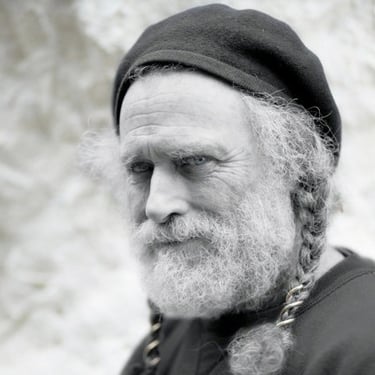
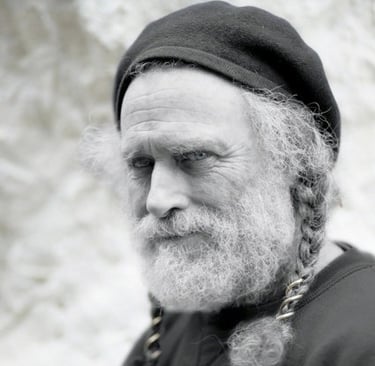
John Fisher / Giovanni Pescatore
Artist Sculptor
MEDIUM: marble
BIO: I traveled throughout Europe and the Middle East as a child which exposed me to the highlights of Western Art. I left home as a teenager to begin my artistic journey. I studied with various teachers along the way, mostly outside conventional educational institutions. To avoid the problems of paying rent I began to live high up in trees, giving me more time to develop my skills.
By my mid thirties, I had found my way back to Italy and to marble. After a few initial small sculptures I decided to go monumental. My first attempt sold through a major New York gallery for a substantial amount of money, allowing myself and my wife Sandy to settle for the next 20 years in Italy. I have gone on to carve over 550 sculptures many of them monumental in scale.
We returned to Northern California to care for aging parents in 2005. Every year we visit Italy for several months to purchase material and to reconnect with friends. My work is scattered throughout the community in which we lived. It is in the churches, banks, schools and cemeteries, as well as private and public places such as shopping malls. I have only a few blocks left and will not be buying any more. My body may be broken but my passion still burns strong.
WEBSITE: JohnFisherSculpture
QUESTION 3. Having worked for decades in Pietrasanta before relocating, how did the physical culture of marble—quarries, tools, community—alter your understanding of scale and ambition?
ANSWER 3. The decades of working in Pietrasanta taught us good work habits, starting early and working late. It provided an unlimited source of high quality material to carve at every possible scale, at little to no cost. I was free to pursue any project that presented itself. Interacting with my colleagues promoted a free exchange of ideas. Every conceivable tool was available to us, including heavy equipment to lift and move massive blocks of stone. I produced approximately 35 pieces a year of every scale. I only needed to sell a fraction of what I made to support our life in Italy. By working directly it meant I was very fast. I never had to refer to a model or take a measurement. This gave me a lot of flexibility in my prices. I knew what we needed to pay the bills and priced accordingly.
QUESTION 1. You begin each sculpture without drawings or models, allowing form to emerge directly from the stone. What tells you when to stop resisting the marble and start listening to it?
ANSWER 1. The intuitive approach to creation avoids the many pitfalls of conscience thought, which often leads to superficial ideas and standard compositions. I remove approximately a third of the material in an abstract exploration before committing to an idea. This gives me time to explore the stone, to learn about any potential problems the block may have. At some random point ideas come to me much like visions in clouds. I patiently wait for those visions to pile up until I have choices. Eventually one of them speaks louder and with more conviction. The mind does not consider the missing stone, only the remaining material. I am seeing my image. I do not need to invent. At that point I switch to another method of only carving the edges or profiles. Profiles are lines not volumes. The line is either correct or incorrect. It is a yes or no answer. If the line needs changing then that marble is removed. When all the profiles are correct the sculpture is finished.
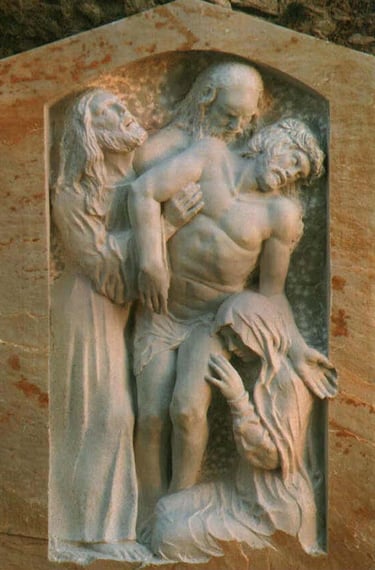
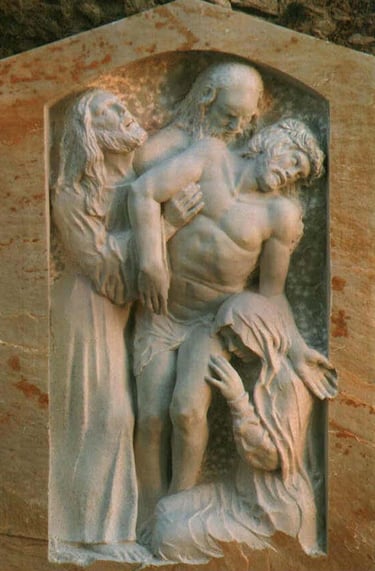
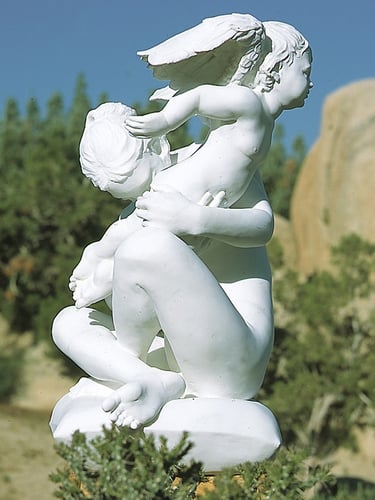
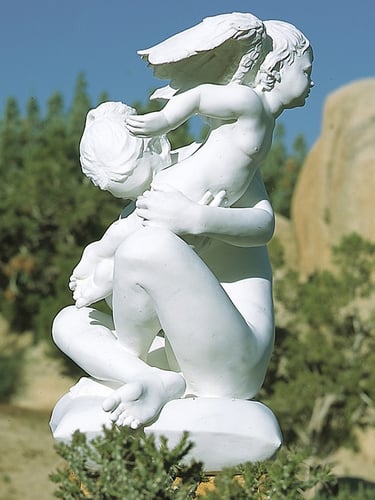
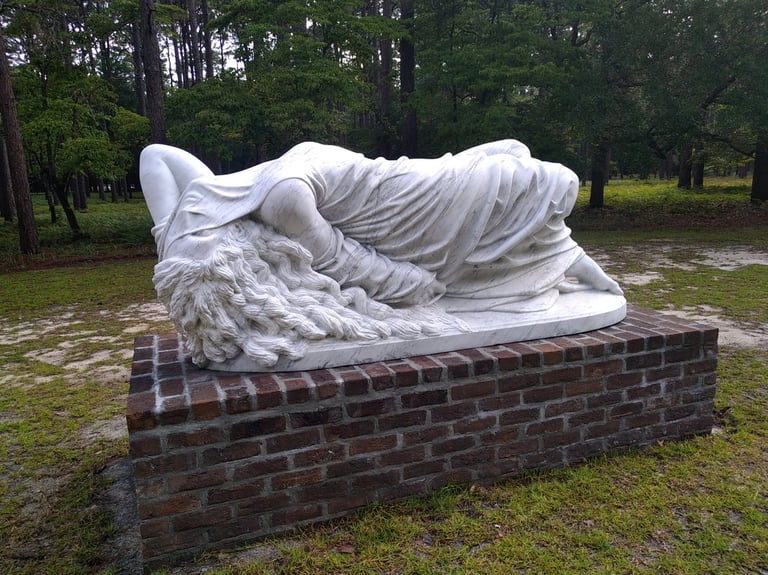
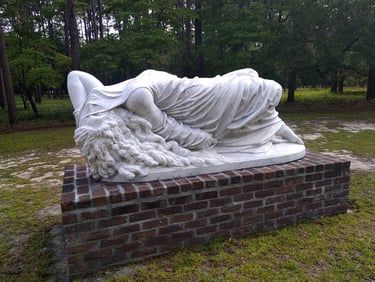
“Ever Oasis” 1988 Marble 4 x 9 x 3 ft. 5 tons
All copyright and reproduction rights are reserved by John Fisher / Giovanni Pescatore.
Artwork may not be reproduced in any form without the artist's express written permission.
CLICK IMAGE FOR FULL VIEW
CLICK IMAGE FOR FULL VIEW
CLICK IMAGE FOR FULL VIEW
“Pietá” 1998 Marble 8 x 5 x 1 ft.
“ Vai con Dio” 1999 Marble 33 x 17 x 16 inches