Three by Three: Guest Artists in Focus
QUESTION 2. Ariadne’s Garden exists as both a physical place and a conceptual extension of your work. How does creating environments for others’ transformation differ from creating images meant to hold that process quietly on their own?
ANSWER 2. Ariadne’s Garden exists for me as a living threshold rather than a fixed distinction between place and image. When I create images, I am crafting silent fields of presence that hold transformation inwardly and at the pace of the viewer’s own readiness. The image waits. It does not intervene; it is available, like an icon or a myth, revealing itself through sustained attention and resonance.
Creating environments for transformation, on the other hand, requires an embodied orchestration of space, time, and relationships. Here, transformation is not only contemplated but enacted somatically and communally. As an artist I do not exist: when I create I lose myself, but as a retreat director I have a role as if as I was an attentive guardian of the threshold, shaping conditions in which participants may safely enter liminal states and return with something integrated.
Yet the two practices are inseparable shaped by the same archetypal intelligence. Ariadne’s Garden, whether encountered as a place or as a symbol of Gaia, invites the same movement with my art: inward toward remembrance, and outward toward relationship—with self, with myth, and with the living world.
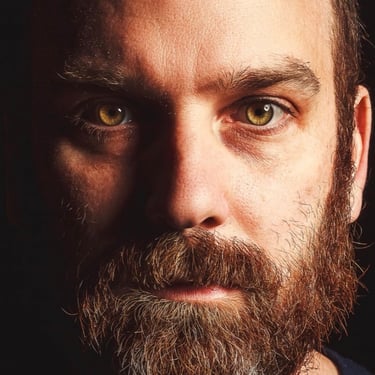
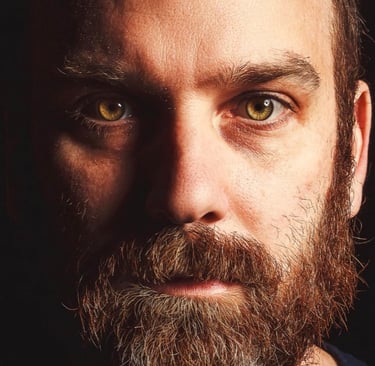
Dimitra Natskouli
Painter
MEDIUM: mixed-media (acrylics, egg tempera, ink, blood)
BIO: Dimitra Natskouli, aka Ieri Pnoi (sacred breath), Artist | Dance Psychotherapist | Retreat Director. Dimitra is a visionary artist, dance therapist, and curator of Ariadne’s Garden of spiritual Arts, a retreat venue & artist residency in Greece. With a background in Philosophy (University of Athens) and an MA in Dance & Movement Psychotherapy (Goldsmiths, London), she has worked with diverse populations—from children to elders, from mental health clinics to creative communities. Her art draws from Byzantine iconography, symbolism, and visionary traditions, offering healing and mythic depth. Dimitra creates and holds spaces where the soul can speak—through paint, movement, silence, and storytelling. Her current therapeutic focus centers on shadow work through archetypal exploration, weaving myth, movement, and the symbolic arts.
INSTAGRAM: @Ieri.Pnoi
QUESTION 3. Shadow work and archetypal exploration are central to your practice. How do you recognize when an image is ready to hold those themes without becoming illustrative or didactic?
ANSWER 3. Archetypal energy is felt somatically. It is universal yet very familiar. There is a quiet charge, a sense that the image has arrived before language. It doesn't justify itself or refine its meaning. It carries ambiguity without collapsing into confusion, and it allows multiple truths to coexist.
I often understand my painting only after it exists. It is like with human relationships: time deepens my understanding. It is a learning process about psychic reality and it is part of my shadow work. This reality shows me that my stories are not purely personal: they are movements of the collective soul flowing in my blood.
I’ve received many responses from people who stand in front of my paintings and feel a sense of recognition. Some say they’ve seen these figures before. I remember one woman in particular who stood quietly with a painting for a long time and then began to tell me the entire story of the figure—its history, its emotional life, its psychic background—as if she were remembering. To be honest I have no idea of what I am painting! Such responses remind me that the paintings don’t belong to me, they rather become meeting places, where the collective soul and the personal story melt in each other.
QUESTION 1. You work with Byzantine iconography not as replication, but as a living language. What drew you to this ancient visual system as a vessel for contemporary psychological and spiritual inquiry?
ANSWER 1. Byzantine iconography emerges from the ancient Greek visual system and later developments such as the Fayum portraits of Egypt. It is a spiritual art in which light does not originate from an external source, but from within the figures themselves, signifying the indwelling grace of God and the potential of theosis—the divinization of the human being. For this reason, shadows are absent. Perspective is inverted: the icon opens toward the viewer, positioning the viewer—not the image—as the focal point of a living dialogue between human and sacred presence.
My own artistic practice, rooted in the archetypal realm and rich in myth and symbol, reflects this ancient visual language in which lived reality and mythology meet within the human psyche. I understand human beings as ancient souls: emanations of the living field of archetypes. Through my work, I create mythic realities—thresholds through which the viewer may enter and encounter themselves mirrored in the archetypal world. These images are alive to eyes capable of resonance.
The Byzantine visual system therefore, beyond being my cultural language, is the most accurate language to share my visions.


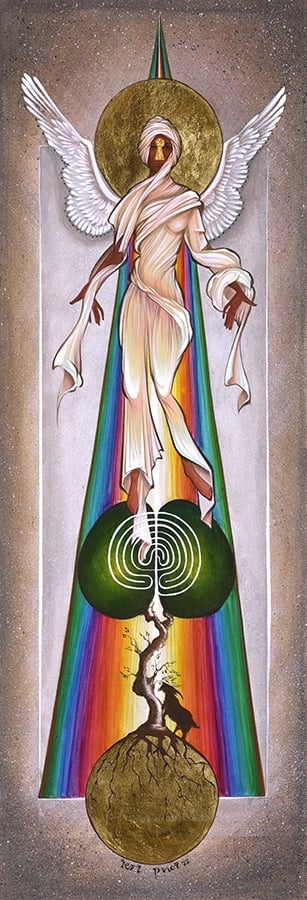
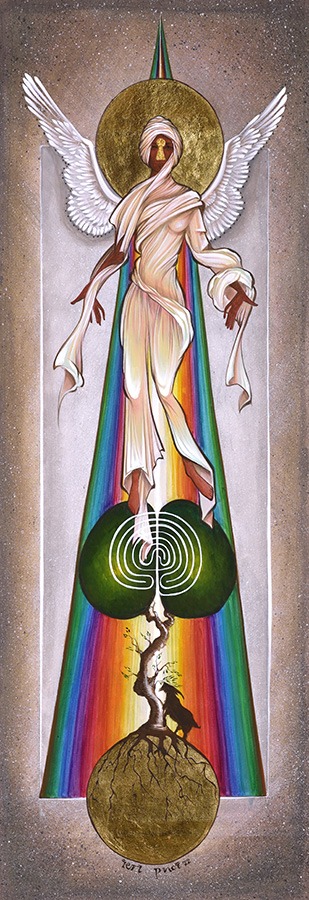
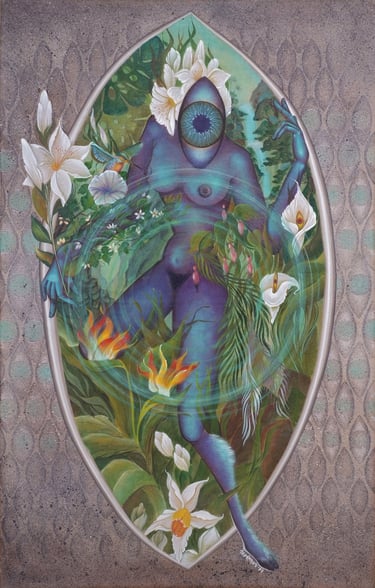
Albedo, 2022, acrylics & gold
leaves on canvas, 25x60cm
Omnipresence, 2023, acrylics on canvas, 70x90cm
Pistis-Sophia, 2025, mixed media on canvas, 100x150cm
All copyright and reproduction rights are reserved by Dimitra Natskouli.
Artwork may not be reproduced in any form without the artist's express written permission.
CLICK IMAGE FOR FULL VIEW
CLICK IMAGE FOR FULL VIEW
CLICK IMAGE FOR FULL VIEW