Three by Three: Guest Artists in Focus
QUESTION 2. Your performances often involve deep listening—both yours and the audience’s. What conditions do you try to create so listening becomes an active, shared experience rather than a passive one?
ANSWER 2. We're always passive listeners of the world around us. We take what we must and go on with our day without truly processing what we have just experienced. There are many creators and practitioners of deep listening whose techniques involve the body, respiration, the use of space... but I feel, deep in my core, that the most important tool here is empathy. When we simply read our work out loud because it satisfies our ego, we are already setting a barrier between us and the audience, and this is so very tangible, so much in spoken word as it is in music and film. But when we become truly present, connect with the needs and messages of our communities, and understand our role as artists and how we can serve others, something in our core changes, and this is what must be transferred back into the world through active engagement, performative or through connection. I'd love to say it has to do with tricks of the trade, but honestly it's my belief that it has to do with actively listening and being present ourselves, so our audiences can feel that connection.
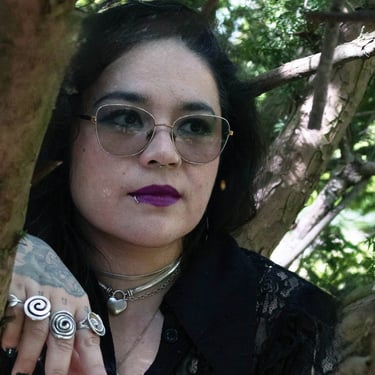
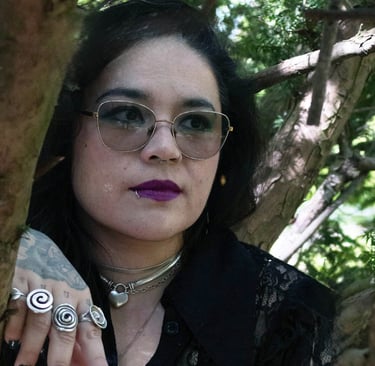
Elizabeth Torres
Poet, Multimedia Artist
MEDIUM: visual arts, performing arts, literature
BIO: Elizabeth Torres (b. 1987), known as Madam Neverstop, is a Colombian-American poet, multimedia artist, translator, and cultural organizer whose practice integrates language, memory, embodiment, and social engagement. Shaped by exile and transnational experience, her work spans poetry, sound, performance, installation, and artistic research, foregrounding listening, relationality, and ethical exchange. She is the author of over twenty poetry books and the founder of major international platforms supporting experimental and marginalized voices. Her practice bridges art, activism, and pedagogy, emphasizing collaborative creation, cultural translation, and social justice across global contexts.
INSTAGRAM: @MadamNeverstop
QUESTION 3. In projects like Poetic Consultations, the encounter is one-to-one and intimate. What have these private exchanges revealed to you about vulnerability that large-scale performances cannot?
ANSWER 3. There's something extremely intimate, heartbreaking and beautiful, in a very vulnerable way, for both the listener and the speaker, when a room is made for human connection, empathy, and holding space for that which is taking up silent room in our hearts and lives. I have been doing long-format sessions or "consultations" since around 2016, which defers from a quick poetic response in that there needs to be at least 20 minutes of conversation, deep, active listening in one-on-one sessions, and then time to process this information, before I respond which usually takes around half an hour or more. The connections felt and the stories shared sometimes are too powerful, moving, tragic, painful or simply too intricate to be taken lightly... and too private / intimate to be shared out in the open, which is why this sudden connection becomes so powerful in ways one doesn't otherwise experience. It has changed me and based on the reactions of the recipients of my poem, it moves something deeply there too and allows for closure, for honoring this part of them in private. I am, however, building up a combination of this practice that involves a collaboration with a curated selection of experimental artists, as a series of performances, where collective listening experiences become the nurturing ground for these one-on-one sessions... a powerful experiment of connecting intimately in both levels simultaneously through day-long immersive sessions for the public.
QUESTION 1. Poetry threads through everything you do, even when the work takes the form of performance, sound, or visual installation. When you step onto a stage, how does a poem behave differently than it does on the page?
ANSWER 1. Through life I learned that poetry is that performing art that allows us to pack an entire theater in our pocket. We have the power of temporarily suspending reality through word and performance, through the embodiment of what must be said, and of course the possibility also of collaborating with colleagues to enhance this experience so it becomes a multimedia immersion that is felt, heard, taken with. I've always seen poetry as my core practice but also as my main instrument, because I do not write simply for the blank page, but for poetry to jump out and take its own shape so it can say, through a circular process of creation, all it has come to say. What do we feel when we read a poem compared to when we hear one? What if it is also seen, how many layers are there?
Title 2
Title 3
Gettin' On With It: https://youtu.be/wxriJYWG220?si=0z-GIYmx50irA5-Y
Cursed with clarity:https://youtu.be/hrqWLCMAa-E?si=etOUtffker7CXwlc
Transmissions from the Bunker - a performance for CUT-UPS: https://youtu.be/FZ6xkchXX0o?si=ap4a7xLlj7AItcbF
All copyright and reproduction rights are reserved by Elizabeth Torres.
Artwork may not be reproduced in any form without the artist's express written permission.
VIDEO
VIDEO
VIDEO